The mitochondrion has long been understood as the primary site of cellular energy production. More recently, however, research has increasingly positioned the mitochondrion as an active participant in cellular signalling, metabolic regulation, and the processes associated with biological ageing. At the centre of this emerging understanding are mitochondrial-derived peptides, a class of bioactive molecules encoded within the mitochondrial genome and increasingly studied for their roles in metabolic homeostasis and longevity-associated pathways.
Two compounds in particular have attracted significant research attention in this context: MOTS-c, a mitochondrial-derived peptide, and NAD+, the essential coenzyme underpinning mitochondrial energy metabolism. Both are available as research-grade compounds from NexGen Research and represent two of the most actively investigated areas in the current longevity science literature.
MOTS-c: mitochondrial signalling in metabolic research
MOTS-c (Mitochondrial Open Reading Frame of the Twelve S rRNA-c) is a 16-amino acid peptide encoded by the mitochondrial genome and first described in published literature in 2015. It is notable for being one of the few peptides known to be encoded by mitochondrial DNA rather than nuclear DNA, placing it at a unique intersection between mitochondrial biology and peptide science.
Preclinical research has examined MOTS-c’s interactions with metabolic pathways including glucose regulation, insulin sensitivity, and lipid metabolism. Studies in animal models have explored its effects on skeletal muscle function, exercise metabolism, and age-related metabolic decline. Of particular interest to researchers is evidence suggesting that MOTS-c levels may decline with age, positioning it as a candidate for research into the relationship between mitochondrial function and the metabolic changes associated with ageing.
Research into MOTS-c remains primarily preclinical and the compound’s mechanisms of action, particularly its nuclear translocation and effects on gene expression, are active areas of investigation. It is important to note that all such research is conducted in controlled laboratory environments and no clinical applications have been established.
NAD+: the coenzyme at the centre of cellular energy
Nicotinamide adenine dinucleotide (NAD+) is not a peptide but a coenzyme present in all living cells and essential to a wide range of biological processes. It functions as a central electron carrier in oxidative metabolism, accepting and donating electrons in the reactions of glycolysis, the tricarboxylic acid cycle, and the mitochondrial electron transport chain.
Beyond its role in energy metabolism, NAD+ is a substrate for several enzyme classes that have attracted significant research attention in the context of ageing biology, including sirtuins (NAD+-dependent deacetylases) and PARPs (poly ADP-ribose polymerases involved in DNA repair). Research published over the past decade has documented age-associated decline in cellular NAD+ levels across multiple organisms and has explored the consequences of this decline for mitochondrial function, DNA repair capacity, and metabolic regulation.
The research into NAD+ precursors and NAD+ itself as a research compound has expanded rapidly, with studies examining intracellular NAD+ dynamics using isotope tracing, the relative efficiency of different NAD+ precursors, and the tissue-specific effects of NAD+ supplementation in animal models.
The intersection of MOTS-c and NAD+ in longevity research
What makes the study of MOTS-c and NAD+ particularly interesting from a systems biology perspective is that both appear to operate within overlapping networks of mitochondrial function and metabolic regulation. Both have been examined in the context of age-related metabolic decline, both interact with pathways relevant to cellular energy homeostasis, and both represent areas where the gap between preclinical findings and clinical understanding remains substantial.
For researchers working in longevity science, metabolic biology, or mitochondrial function, these compounds represent well-characterised research tools with an established and growing body of published literature to contextualise experimental design and findings.
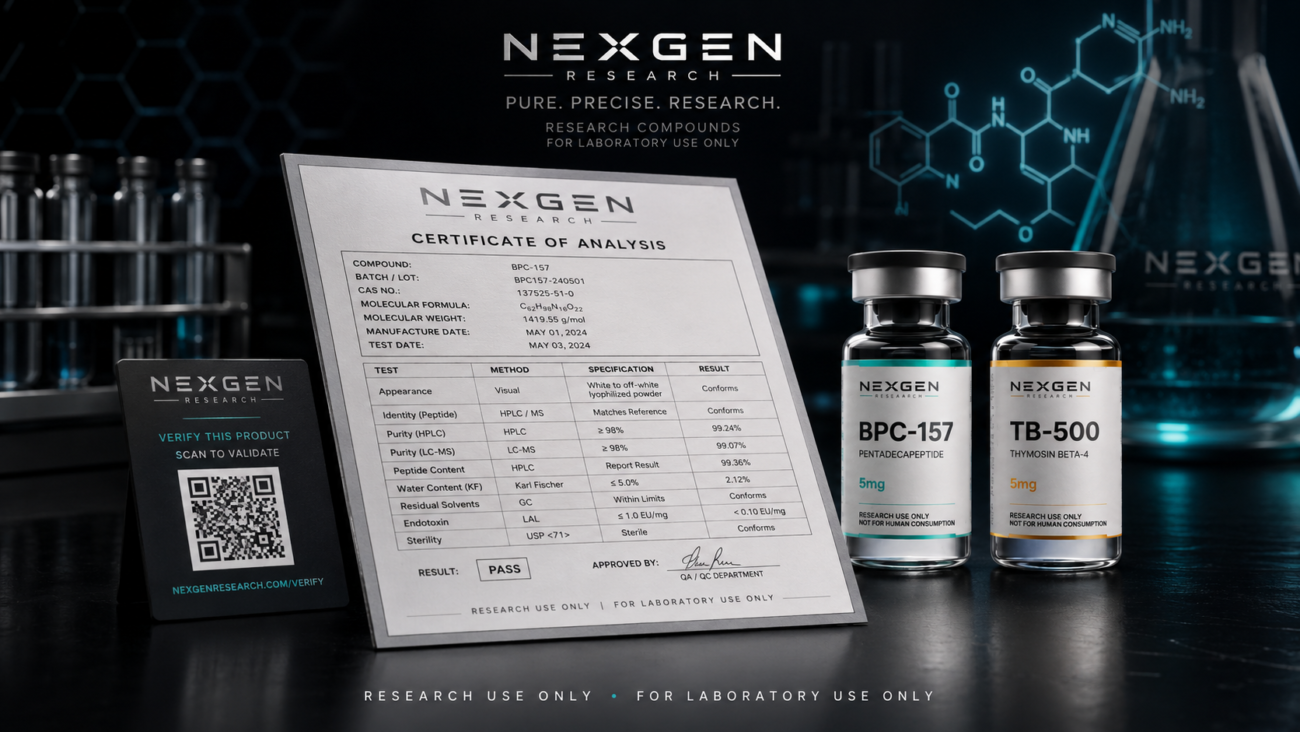
Both MOTS-c and NAD+ are available as research-grade compounds from NexGen Research with full certificates of analysis on every batch.