The growth hormone releasing hormone (GHRH) axis represents one of the most well-characterised peptide signalling systems in endocrinological research. Comprising the hypothalamus, anterior pituitary, and a range of regulatory peptides and receptors, this axis governs the pulsatile secretion of growth hormone (GH) and has been the subject of extensive preclinical and clinical investigation over several decades.
For researchers studying growth hormone physiology, body composition regulation, metabolic function, and related areas, a range of synthetic peptide analogues of GHRH and ghrelin have become important research tools. Among the most widely studied are CJC-1295, Ipamorelin, and Sermorelin, each of which interacts with the GHRH axis through distinct mechanisms and with different pharmacokinetic profiles.
The GHRH axis: a brief overview
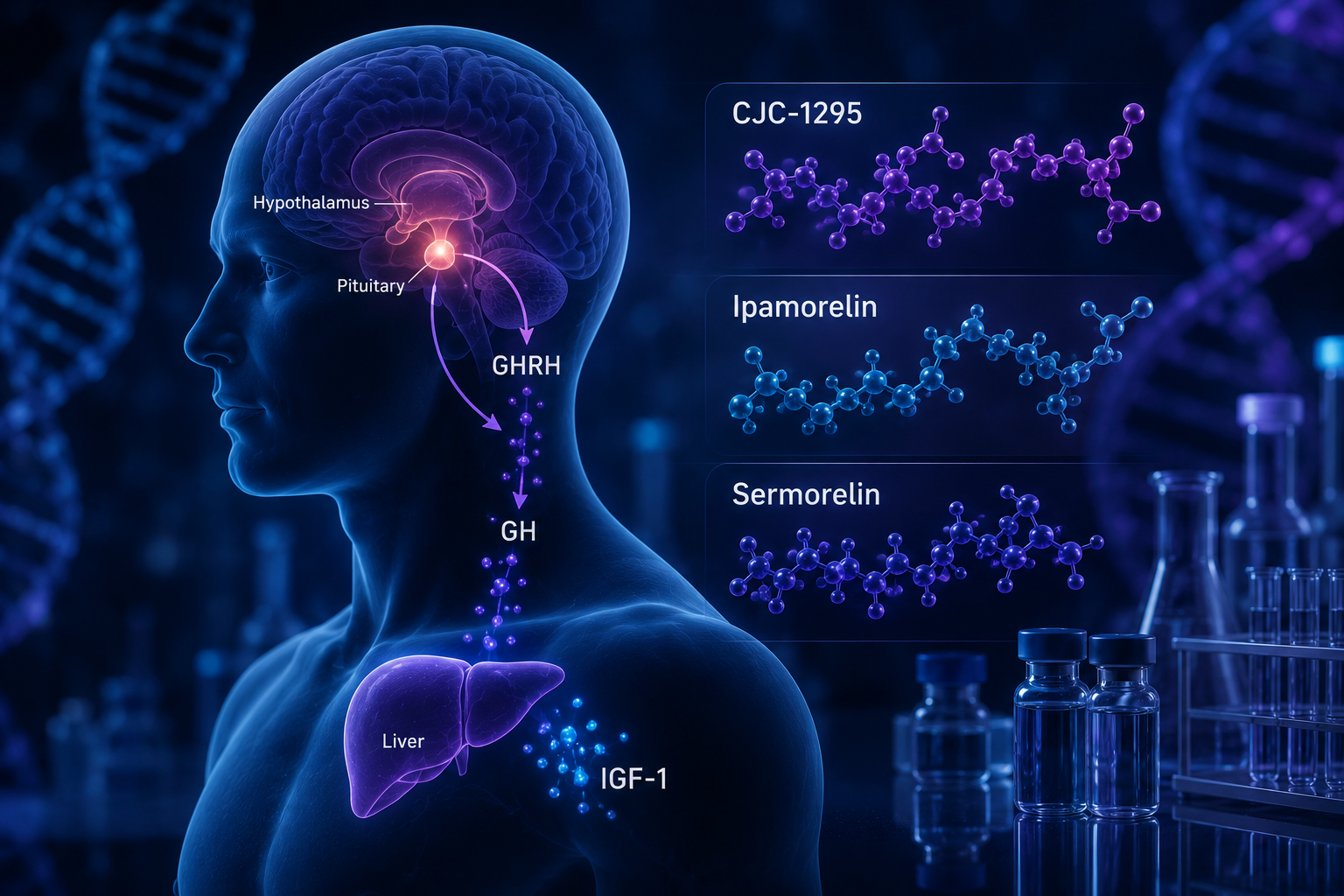
Growth hormone releasing hormone is a 44-amino acid peptide produced in the arcuate nucleus of the hypothalamus. It acts on somatotroph cells in the anterior pituitary via the GHRH receptor to stimulate the synthesis and pulsatile release of growth hormone. This release is modulated by multiple factors including somatostatin (which inhibits GH release), ghrelin (which stimulates GH release via a separate receptor, the GHS-R), and negative feedback from circulating insulin-like growth factor 1 (IGF-1).
Understanding the GHRH axis requires appreciating its pulsatile nature. GH is not secreted continuously but in discrete pulses, particularly during slow-wave sleep and in response to exercise and fasting. The amplitude and frequency of these pulses decline with age, a phenomenon that has driven substantial research interest in compounds that interact with GHRH signalling.
CJC-1295 No DAC: a stable GHRH analogue
CJC-1295 is a synthetic analogue of GHRH designed to extend the biological half-life of the native GHRH peptide. Native GHRH is rapidly degraded by endogenous enzymes including dipeptidyl peptidase IV (DPP-IV), limiting its utility as a research tool. CJC-1295 incorporates specific amino acid substitutions that confer resistance to DPP-IV cleavage, significantly extending its duration of action compared to native GHRH.
The No DAC (no drug affinity complex) version of CJC-1295 is the most commonly used form in research settings, offering a more manageable pharmacokinetic profile than the DAC-modified version. Research with CJC-1295 No DAC has examined its effects on GH pulse amplitude, IGF-1 modulation, and interactions with co-administered GH secretagogues.
Ipamorelin: a selective GH secretagogue
Ipamorelin is a pentapeptide GH secretagogue that acts via the ghrelin receptor (GHS-R1a) to stimulate GH release. It is notable for its high selectivity, stimulating GH secretion with minimal effects on cortisol, prolactin, or ACTH at research-relevant concentrations – a profile that distinguishes it from earlier generation GH secretagogues and makes it a useful research tool for studying isolated GH secretagogue activity.
Research with Ipamorelin has examined its GH-releasing properties, its selectivity profile compared to other GHS-R agonists, and its interactions with GHRH analogues. The combination of a GHRH analogue such as CJC-1295 with a GH secretagogue such as Ipamorelin is a commonly studied pairing in preclinical research due to their complementary mechanisms of action.
Sermorelin: the native GHRH analogue
Sermorelin is a 29-amino acid synthetic peptide corresponding to the first 29 amino acids of native human GHRH and represents the shortest fragment of GHRH known to retain full biological activity at the GHRH receptor. It was one of the earliest GHRH analogues used in research and has an established body of published literature spanning several decades.
Compared to CJC-1295, Sermorelin has a shorter half-life and more closely mimics the pulsatile signalling pattern of native GHRH. For researchers studying the temporal dynamics of GHRH receptor signalling or requiring a research tool with a shorter duration of action, Sermorelin offers a well-characterised option with substantial published precedent.
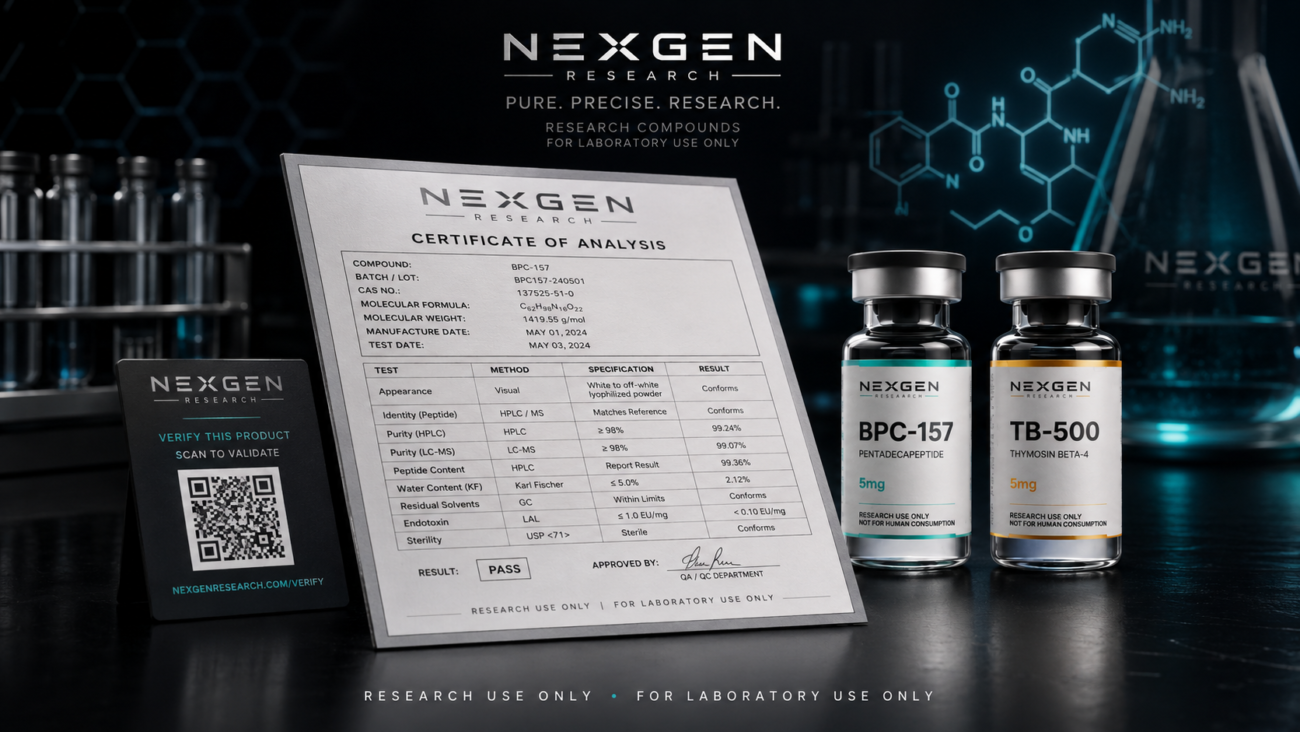
All three compounds – CJC-1295 No DAC, Ipamorelin, and Sermorelin – are available as research-grade compounds from NexGen Research with full batch-specific certificates of analysis.